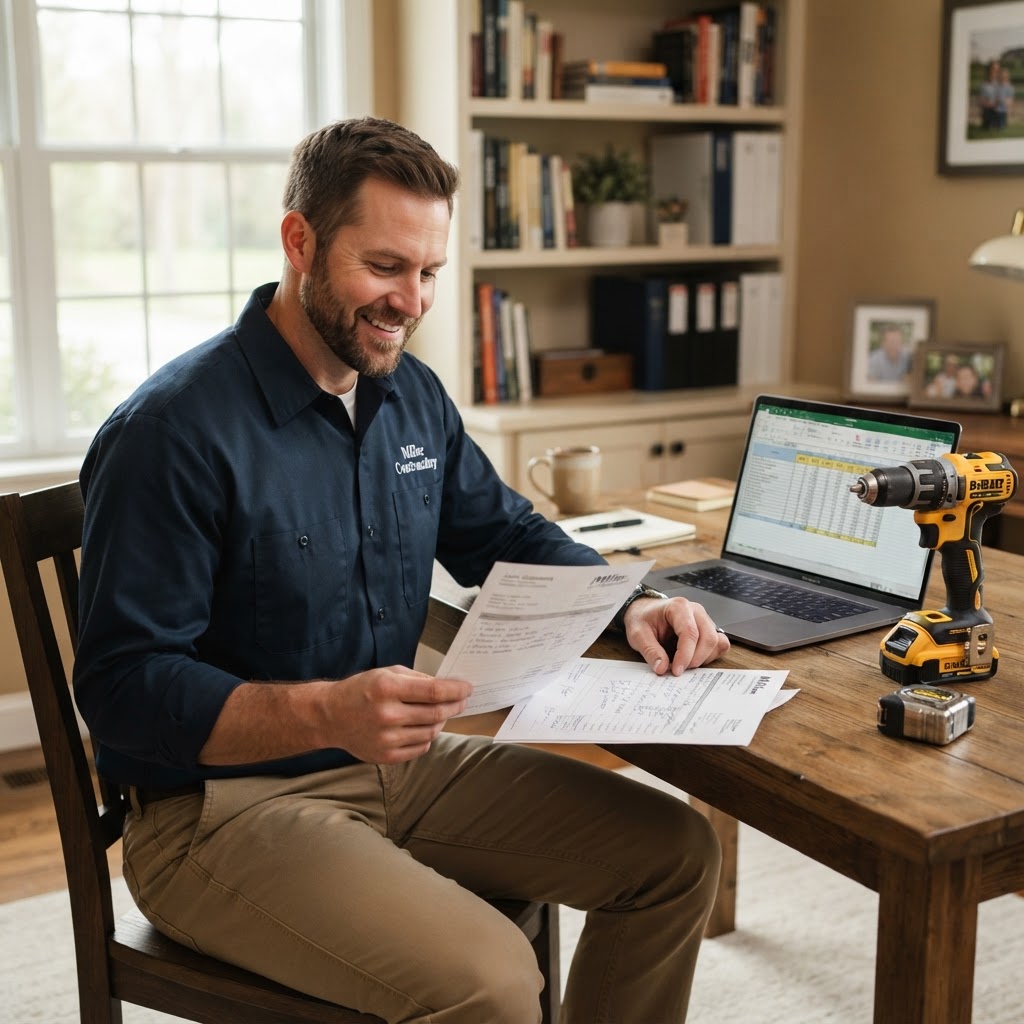
How to Price Your Services for Maximum Profit
Struggling to set prices that actually grow your business? This guide breaks down proven pricing strategies built specifically for home service contractors and tradespeople in the United States. Learn how to cover costs, stay competitive, and maximize your profit on every job.

How to Price Your Services for Maximum Profit
Most contractors leave thousands of dollars on the table every single year. Not because they do bad work, but because they guess at their prices instead of calculating them.
If you're tired of staying busy but still struggling to make real money, this is for you.
The Biggest Pricing Mistake Contractors Make
They price based on what the competition charges.
You call around, check what other plumbers or painters in your area are charging, then set your rates slightly lower to "win more jobs." Sounds logical. It's actually one of the fastest ways to run a thin-margin business that grinds you into the ground.
Your competitor might own their truck outright. You're still paying it off. They might have two guys doing the work. You have four. Their insurance situation might be completely different from yours. Copying their price without knowing their costs is like copying someone's exam answers without knowing what subject they're studying.
Price based on YOUR numbers. Always.
Know Your Real Costs Before You Quote Anything
This is where knowing how to price your services for maximum profit actually starts. Not with what to charge, but with what it costs you to operate.
Direct Costs
These are the costs tied to a specific job:
- Materials and supplies
- Subcontractor labor (if you bring in extra hands)
- Equipment rental for the job
- Fuel and drive time to the site
- Permits and inspection fees
A roofer in Florida replacing a 2,000 square foot roof needs to account for every bundle of shingles, the underlayment, flashing, nails, dumpster rental, and the time his crew spends driving to the job site.
Overhead Costs
These are the costs of keeping your business running whether you're on a job or not:
- Truck payments and maintenance
- Insurance (general liability, workers' comp, vehicle)
- Tools and equipment depreciation
- Phone, software, and admin costs
- Your license renewal fees
- Marketing costs
Add all your monthly overhead up. If it comes to $8,000 a month and you work 20 billable days, you need to recover $400 per day just to break even on overhead. That's before you pay yourself a single dollar.
A lot of guys skip this step. Then they wonder why there's nothing left at the end of the month.
Calculate Your Real Hourly Rate
Here's a straightforward way to figure out what you actually need to charge per hour.
- Write down your total monthly overhead (let's say $6,000)
- Add in what you want to pay yourself (let's say $8,000 per month)
- That's $14,000 you need to bring in per month
- Now estimate how many billable hours you actually work (not total hours, billable ones)
- If you bill 120 hours a month, divide $14,000 by 120
- That gives you a base rate of around $117 per hour
That's your break-even point. You haven't made any profit yet.
Add your profit margin on top of that. Most successful trade businesses target somewhere between 15% and 30% net profit depending on the trade and market. So in this example, you'd be looking at charging somewhere between $135 and $152 per hour minimum.
An HVAC technician in Texas working solo might find this puts them at $140 to $160 per hour for labor. In California, especially around Los Angeles or the Bay Area, that number can push well past $200 per hour once you factor in higher insurance costs, licensing requirements, and the cost of living impacting what your employees expect to earn.
Flat Rate vs. Hourly: Which One Wins?
Both work. But flat rate pricing tends to win for most trades.
When you charge by the hour, customers watch the clock. They second-guess how long things take. They ask questions like "how long do you think this will take?" and then feel overcharged when it runs long. It also punishes you for getting faster and more efficient at your job.
Flat rate pricing means you quote the job, not the time. A licensed electrician in Florida who knows it typically takes 3.5 hours to install a new circuit and panel breaker can build that time plus materials plus profit into a flat price of, say, $450. If he gets good at the job and does it in 2.5 hours, he makes more per hour. The customer knows exactly what they're paying upfront.
Flat rate also removes the awkwardness of telling a client the job took longer than expected.
The key is building your flat rates on accurate time estimates. Track how long jobs actually take. Not how long you think they take. Write it down, job by job, for a few months. The data will surprise you.
Stop Competing on Price
If you're the cheapest option in your market, you're not winning. You're just attracting the most difficult customers.
People who hire the lowest bidder are also the ones who question every line on your invoice, ask for extras without wanting to pay for them, and leave you a bad review when something minor goes wrong. High-value customers want quality and reliability. They're not shopping solely on price.
Here's what actually wins jobs at higher prices:
- Showing up on time and communicating clearly
- Professional invoices and quotes
- Good reviews on Google
- Clean trucks and presentable appearance
- Following up after the job is done
A painting contractor in Houston who charges $3,500 for an exterior paint job and has 80 five-star reviews will win against the guy charging $2,800 with three reviews and a generic quote scribbled on paper. Every time.
Factor In the Jobs You Don't Get
When you price a job, you're also pricing for the fact that you won't win every bid.
If you quote 10 jobs and win 7, your pricing and close rate are probably solid. If you quote 10 and win 10, you're almost certainly too cheap. A win rate of 60% to 75% is a healthy target for most residential contractors. It means you're leaving some money on the table sometimes, but you're not consistently underpricing yourself.
Raise your prices until your win rate drops to somewhere in that range. It sounds counterintuitive. It works.
Use Tiered Options When You Quote
Give customers a choice between two or three packages.
A landscaper in California might quote a job like this:
- Basic: Lawn mow, edge, and blow for $180
- Standard: Mow, edge, blow, plus shrub trimming and a bag of mulch for $295
- Premium: Everything in Standard plus seasonal planting and a fertiliser treatment for $420
Two things happen. First, many customers pick the middle or top option because they want a good result and the upgrade feels reasonable. Second, you stop competing purely on the lowest price because you're showing value at every level.
This works especially well for cleaning companies, landscapers, painters, and general maintenance contractors.
Adjust for Market Conditions and Seasons
Pricing isn't static.
A plumber in Tampa or Orlando can charge more during peak snowbird season when demand is high and customers want fast service. An HVAC tech in Dallas in July is in a completely different demand situation than in February. If your schedule is full two weeks out and you're turning away jobs, your prices are too low.
Raise them. You'll do the same amount of work and make more money.
On the flip side, if winter slows you down and you need to fill the calendar, you can run promotions or offer off-season rates to keep revenue coming in without permanently cutting your standard prices.
Keep Tracking and Adjusting
Your pricing isn't something you set once and forget.
Material costs go up. Insurance premiums rise. Fuel prices shift. Labor costs climb, especially if you're hiring. Review your pricing at least twice a year. Look at your job costs versus your quotes and see where you're losing margin.
If you quoted a bathroom renovation at $4,200 and it actually cost you $3,900 to complete, that's a thin margin. Figure out what went wrong and fix the quote template.
Use the Right Tools to Stay on Top of It
Quoting jobs in your head or on a scratchpad means you're constantly guessing. Good tools help you build accurate quotes faster, track job costs, and see where your profit is actually coming from.
Onwork is built specifically for home service businesses. It helps contractors quote jobs, manage invoices, and keep their numbers organised without needing an accountant on speed dial. If you want to tighten up your pricing and actually see your profit in real time, it's worth checking out.
Knowing how to price your services for maximum profit isn't about charging the most in your market. It's about knowing your costs, adding real margin, and building a business that makes money consistently. Get that right and everything else gets easier.
Disclaimer: It is the user’s responsibility to verify the information in this article and seek professional advice where appropriate. Onwork provides this content for general informational purposes only and does not accept responsibility for decisions made based on it.