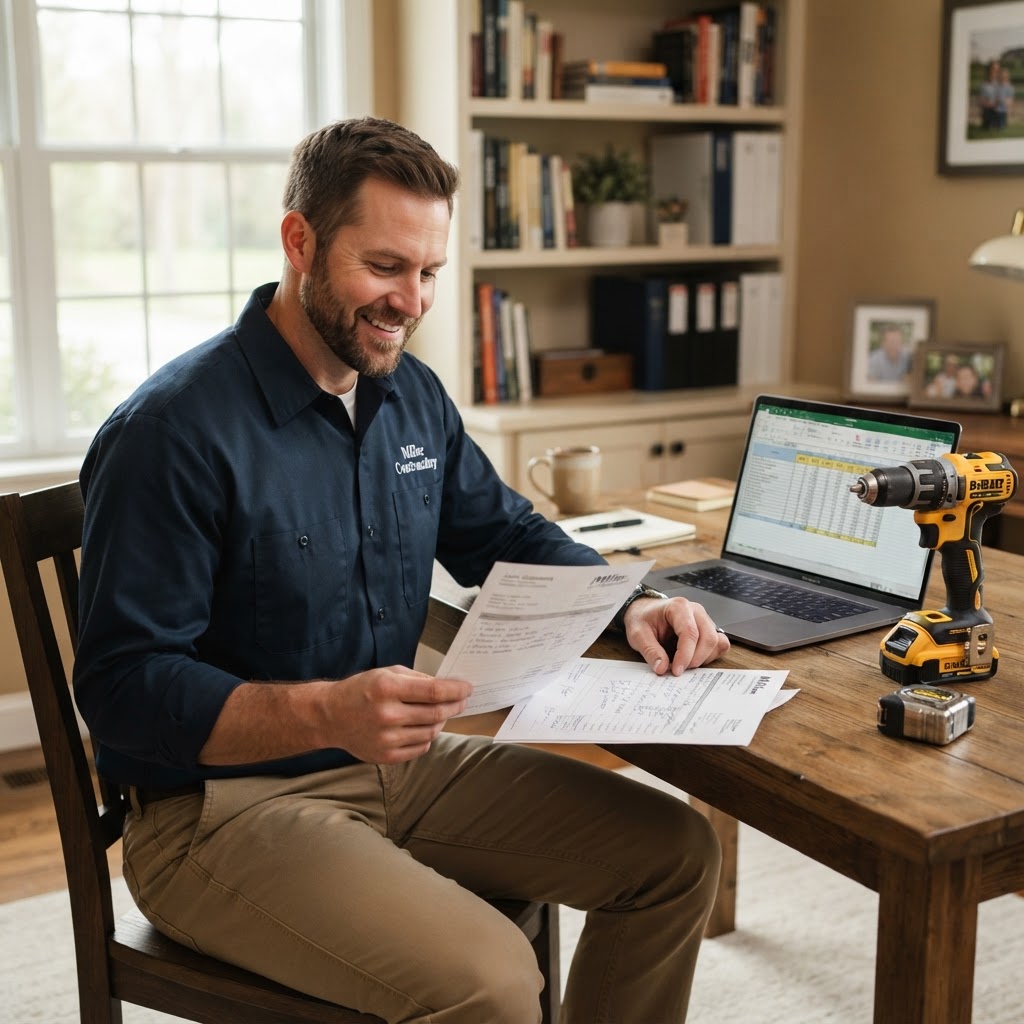
How to Price Your Services for Maximum Profit in 2025
Underpricing your services is one of the fastest ways to kill your contracting business. Learn how to calculate your true costs, set competitive rates, and confidently charge what you're worth. Whether you're a plumber, electrician, or general contractor, these pricing strategies will help you build a more profitable business.

How to Price Your Services for Maximum Profit in 2025
Most contractors leave thousands of dollars on the table every year. Not because they do bad work, but because they guess at their prices instead of calculating them. Here is how to fix that.
Why Your Pricing is Probably Wrong Right Now
If you set your rates based on what the guy down the street charges, you are already behind. A lot of tradespeople in Texas, California, and Florida do this. They match a competitor's price, win the job, then wonder why they are exhausted and barely breaking even by December.
The truth is simple. Your costs are not the same as your competitor's costs. Your truck payment, your insurance, your crew size, your drive time, all of that is different. Pricing based on someone else's numbers is like wearing someone else's boots. It might work for a while, but it will eventually hurt you.
Start With Your Real Costs, Not a Guess
Before you can figure out how to price your services for maximum profit, you need to know exactly what it costs you to operate for one hour. This is called your break-even hourly rate, and most contractors have never actually sat down and calculated it.
Here is how to do it:
Add Up Your Fixed Monthly Costs
These are the bills that show up whether you work or not:
- Truck payments and vehicle insurance
- Business insurance and liability coverage
- Tool replacement and equipment loans
- Office software, phone, and internet
- Any employee wages or subcontractor retainers
- Advertising and marketing spend
If those total $8,000 a month, that is your floor. You have not made a cent of profit yet.
Calculate Your Billable Hours
This is where most people get it wrong. You work 40 hours a week, but you are not billing 40 hours. You are driving, quoting, ordering materials, doing admin. A realistic billable hour count for a solo contractor is usually between 100 and 120 hours per month.
So if your fixed costs are $8,000 and you bill 100 hours a month, your break-even rate is $80 per hour. That is before materials. That is before profit. That is just to keep the lights on.
Build in Your Profit Margin
Profit is not a bonus. It is part of the price. A lot of tradespeople treat profit like whatever is left over at the end. That is backwards.
Decide on a profit margin before you quote anything. For most home service businesses in the US, a healthy net profit margin sits between 15 and 25 percent. Some specialty trades in high-demand markets, think HVAC in Houston or electrical work in Los Angeles, can push that to 30 percent or more.
Using the example above, if you want a 20 percent profit margin on top of your $80 break-even rate, your minimum billable rate becomes around $96 to $100 per hour.
That is your floor. Not your price.
Understand What the Market Will Actually Pay
Knowing your costs tells you your minimum. Knowing your market tells you your maximum. These two numbers define your pricing range.
Here are some rough 2025 benchmarks for common trades across major US markets:
- Plumbers: $100 to $200 per hour. Higher in California urban areas.
- Electricians: $85 to $175 per hour. Demand is strong in Florida right now with all the new construction.
- HVAC technicians: $75 to $150 per hour plus parts. Texas summers keep this rate firm.
- Roofers: Usually project-based, but day rates can run $500 to $900 per crew member.
- Landscapers: $50 to $100 per hour depending on services and location.
- Painters: $40 to $80 per hour or by square footage.
- House cleaners: $25 to $50 per hour or flat rates per visit.
- General contractors: Typically 10 to 20 percent on top of project costs.
If your current rate sits at the very bottom of your trade's range, you have room to move. You do not need to be the most expensive, but you should not be the cheapest either.
Use a Flat Rate Pricing Model Where You Can
Hourly pricing is fine, but flat rate pricing is usually better for your bottom line. Here is why.
When you charge by the hour, slow days cost you money. If a job takes you three hours instead of two because you hit a snag, you eat that time. With flat rate pricing, you quote the job, not the clock.
A plumber in Dallas charging $250 flat to replace a toilet fill valve is quoting about 1.5 hours of work. If he finishes in 45 minutes because he is good at it, he just made $200 per hour. That is what skill and experience should earn.
How to Build a Flat Rate Price
- Estimate how long the job takes on average, not your best day, the average day
- Multiply by your target hourly rate
- Add materials plus a 10 to 20 percent markup on materials
- Add a buffer for complexity, usually 10 to 15 percent
So a standard bathroom faucet replacement might look like this:
- 1.5 hours at $95 per hour = $142.50
- Faucet and supplies at cost: $85, marked up 15 percent = $97.75
- Complexity buffer (10 percent): $24
- Total flat rate quote: $265
That is a clean, professional number that covers your costs and builds in profit.
Stop Competing on Price
If you are winning every single job you quote, your prices are too low. Seriously. A healthy win rate for most contractors is somewhere between 60 and 75 percent. If you are closing 90 percent of quotes, you are undercharging.
Raise your prices and lose a few jobs. The jobs you keep will pay you more. You will work the same hours for better money.
The contractors who compete only on price are usually the ones who go out of business or burn out within five years. In markets like Miami, Austin, or San Diego where the cost of living is high, cutting prices to win work is a fast track to losing money.
Adjust for Job Type and Urgency
Not all jobs should be priced the same way.
Emergency work should carry a premium. A burst pipe at 11pm is not the same as a scheduled bathroom renovation. Charge accordingly. An after-hours call-out fee of $150 to $250 on top of your normal rate is completely standard.
Repeat customers and maintenance contracts can come with a small discount built in, but structure it properly. A 5 percent loyalty discount on a recurring landscaping contract still makes money if your base rate is solid.
Large projects deserve a proper markup on materials. If you are managing $30,000 worth of materials on a roofing job in Florida, a 15 percent markup on those materials adds $4,500 to your revenue. That is real money for work you are already doing.
Review Your Prices at Least Twice a Year
Material costs in the US have been volatile. Lumber, copper, PVC, fuel, all of it shifts. If you quoted a job in January based on material prices from last year, you could be eating the difference.
Set a reminder every six months to review your cost calculations. If your truck insurance went up, if diesel is higher, if your supplier raised their prices, your rates need to reflect that.
Most customers will not push back on a small rate increase if you do good work and communicate professionally. A note like "Due to increased material and fuel costs, our rates have been updated as of March 2025" is enough. You do not need to over-explain it.
Common Pricing Mistakes to Avoid
- Not charging for travel time: If you are driving 45 minutes to a job, that time has value. Build it in.
- Forgetting about taxes: Set aside at least 25 to 30 percent of profit for self-employment and income taxes. The IRS does not negotiate.
- Quoting from memory: Always use a written quote. It protects you and looks professional.
- Ignoring scope creep: If the job changes, the price changes. Get any additions approved in writing before you do the extra work.
Start Getting Paid What You Are Worth
Figuring out how to price your services for maximum profit is not complicated, but it does take some honest number-crunching. Know your costs. Set a profit target. Understand your market. Then charge accordingly and stop apologising for it.
Good pricing is what keeps your business alive and keeps your family paid.
If you want to make the quoting and admin side easier, take a look at Onwork. It is built for home service businesses and helps you create professional quotes, track jobs, and manage your work in one place, so you spend less time on paperwork and more time on the tools.
Disclaimer: It is the user’s responsibility to verify the information in this article and seek professional advice where appropriate. Onwork provides this content for general informational purposes only and does not accept responsibility for decisions made based on it.