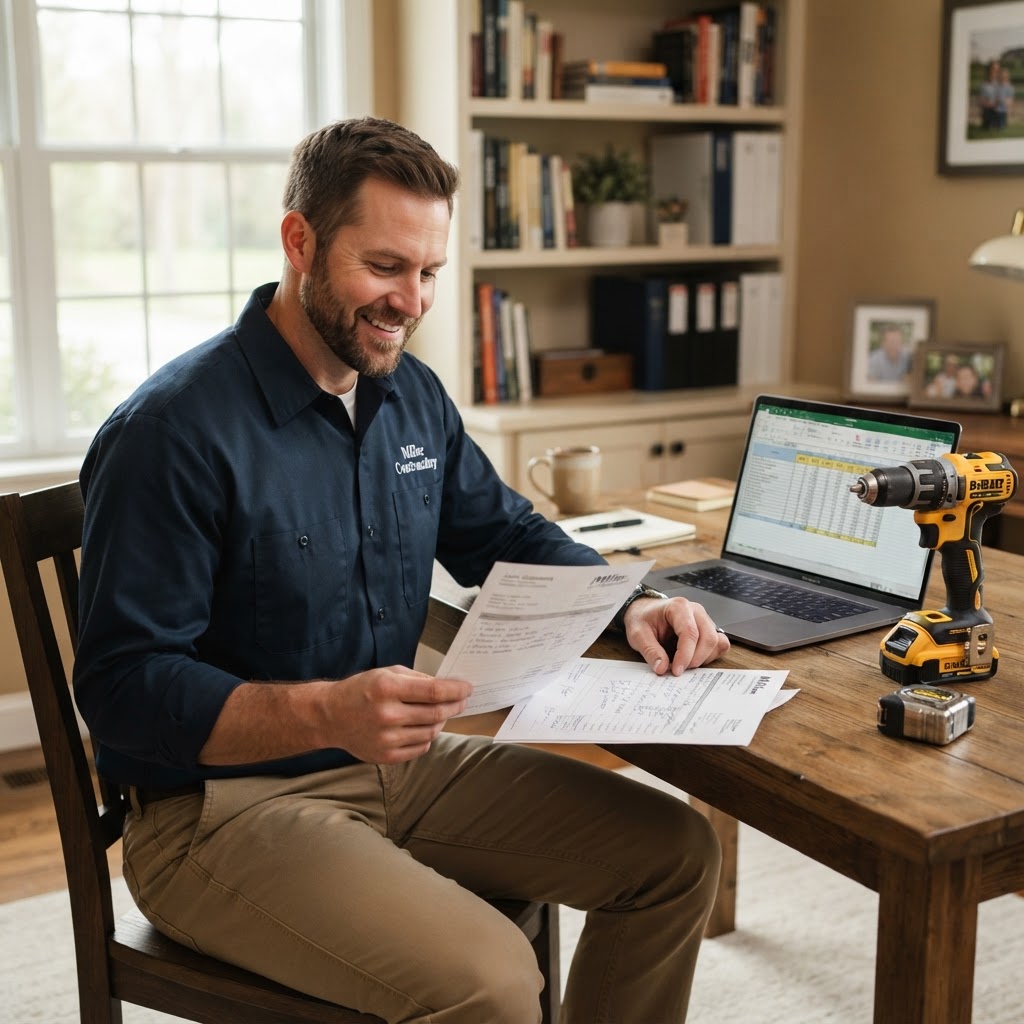
How to Price Your Services for Maximum Profit in 2025
Undercharging is one of the biggest mistakes home service business owners make. This guide breaks down proven pricing strategies to help contractors and tradespeople across the U.S. cover costs, stay competitive, and maximize profit on every job.

How to Price Your Services for Maximum Profit in 2025
Most contractors leave serious money on the table. Not because they do bad work, but because they guess at their prices instead of building them properly. That stops today.
Why Most Tradespeople Underprice Their Work
Here's the uncomfortable truth. A lot of guys in the trades set their rates by looking at what the competitor down the street charges, then going a little lower to win the job. That strategy works great if your goal is to stay broke.
Your competitor might have a spouse with a full-time income. They might be running down old equipment they bought years ago. They might not be paying for proper insurance. You have no idea what their actual costs are, so copying their price tells you nothing useful.
Figuring out how to price your services for maximum profit starts with your own numbers, not someone else's.
Start With Your Real Costs
Before you charge a single dollar, you need to know what it costs you to open your truck in the morning.
Add up everything:
- Truck payment or depreciation
- Fuel (a plumber in Houston driving 30 miles a day spends $400+ per month on gas alone)
- Insurance (general liability, workers comp if you have employees)
- Tools and equipment replacement
- Software, phone, admin costs
- Your own salary (yes, pay yourself like an employee first)
- Taxes (self-employment tax in the US runs around 15.3% on top of income tax)
Let's say your real monthly overhead comes to $8,000. If you work 20 billable days a month and 8 hours a day, that's 160 billable hours. Just to break even, you need to bill $50 per hour before you make a single dollar of profit.
Most painters in Florida or landscapers in Texas are charging $45 to $55 per hour and wondering why they have nothing left over. That's why.
Set a Real Profit Target
Breaking even is not a business. It's a slow-motion disaster.
Decide what profit margin you actually want. For most home service businesses, a net profit margin of 15% to 25% is healthy. Some specialists, like electricians doing commercial panel work in California, can push higher.
Here's a simple formula:
Hourly Rate = (Monthly Overhead + Owner Salary + Profit Target) / Billable Hours
Example: Say your overhead is $6,000 per month, you want to pay yourself $7,000, and you want $3,000 in profit. That's $16,000 total. At 150 billable hours a month, your minimum rate is about $107 per hour.
If you're currently charging $75 an hour, you're not running a business. You're running a charity for homeowners.
Flat Rate vs. Hourly: Which One Wins?
Both models work. The question is which one protects your profit better in different situations.
Hourly Pricing
Hourly is straightforward and good for jobs where scope is hard to predict, like troubleshooting an electrical fault or diagnosing an HVAC issue. The downside is that efficient tradespeople get penalised. If you can replace a hot water heater in 90 minutes because you've done it 500 times, billing two hours feels wrong to the customer and caps your earnings.
Flat Rate Pricing
Flat rate is where most experienced contractors make more money. You price the job, not the clock. If you quote $450 to replace a bathroom faucet and you knock it out in an hour, your effective hourly rate is $450. That's the reward for your skill and speed.
The key is building your flat rates off real data. Track how long each job type takes you over 20 or 30 jobs. Then price based on that average, not your best day.
Many HVAC techs in Texas use flat rate books as a starting point, then adjust based on their local market and actual job costs.
Factor In the Jobs You Can't Bill For
This one gets overlooked constantly.
Not every hour you work is a billable hour. You drive to the supply house. You write quotes. You answer calls. You wait on a slow delivery. If you work 50 hours a week but only bill 30 of them, your real hourly cost is based on those 30 hours, not 50.
Always account for non-billable time when calculating your rates. A rough rule is that most solo operators can realistically bill 60% to 70% of their working hours.
How to Price Different Job Types
Small Repair Jobs
Don't undercharge small jobs just because they're quick. A service call minimum of $95 to $150 is completely normal in markets like Orlando, Sacramento, or Dallas. Cover your drive time, admin, and truck costs. You're not doing anyone a favour by showing up for $40.
Bigger Projects
For anything over a day's work, switch to project pricing. Break it down like this:
- Calculate your material costs accurately (add 10% to 15% for waste and surprises)
- Estimate your labour hours realistically, then add 20% buffer
- Multiply labour hours by your true hourly cost
- Add your overhead allocation
- Add your profit margin on top
If you skip step five, you're working for free.
Recurring Service Contracts
Maintenance contracts are gold. A landscaper in California locking in 40 homes at $180 per month has $7,200 in guaranteed monthly revenue before they pick up a single new job. HVAC companies with maintenance agreements are far more stable than those chasing one-off installs.
Price these slightly below your standard rate to reward the commitment, but make sure they're still profitable.
Stop Being Afraid to Raise Your Prices
A lot of tradespeople are terrified that raising prices will kill their business. Here's what actually happens for most of them: they raise prices, lose maybe 10% to 15% of their worst clients (usually the ones who gave them the most grief anyway), and end up making more money on fewer jobs with less stress.
You don't need every job. You need the right jobs at the right price.
If you haven't raised your rates in two years, you're actually charging less than before because of inflation. Materials are up. Fuel is up. Insurance premiums have jumped. Your rate from 2022 is worth less in 2025 dollars.
Raise your prices. Tell customers you're doing it. Most of the good ones won't walk.
What the Market Will Bear
Knowing your costs sets your floor. The market sets your ceiling.
Do some real research. Call around as a "customer" and get quotes. Check Angi, Thumbtack, and HomeAdvisor listings in your area. Talk to other contractors at supplier counters. In South Florida, roofing prices are higher than rural Tennessee because demand, cost of living, and insurance requirements are all different.
Price to your market, but never below your cost floor.
Quote Confidently and Stop Discounting
When you give a quote, say the number clearly and stop talking. A lot of contractors undermine themselves by nervously over-explaining or offering a discount before the customer even asks.
If someone says your price is too high, ask what they're comparing it to. Often they're comparing you to someone without proper insurance or the right license. That's not a fair comparison and it's worth saying so calmly.
Discounting occasionally to win a big job is a tactic. Discounting out of fear every single time is a habit that destroys margins.
Use Technology to Protect Your Margins
Quoting jobs in your head or on paper scraps leads to mistakes. You forget to include materials. You forget drive time. You quote from memory on a job type you haven't done in eight months.
Good quoting software forces you to be thorough. It makes sure every cost shows up in the final price before you send it to the customer.
Final Thoughts
Learning how to price your services for maximum profit is not complicated. But it does require you to be honest about your costs, clear about what profit means to you, and confident enough to charge what the work is actually worth.
Know your numbers. Build your rates from the bottom up. Stop copying competitors who might be going broke at their own prices. And raise your rates when your costs go up.
Your skills have real value. Price them that way.
Ready to quote faster and more accurately? Check out Onwork, a tool built for home service businesses that helps you create professional quotes, track jobs, and manage customers all in one place. Less time on paperwork means more time doing the work that actually pays.
Disclaimer: It is the user’s responsibility to verify the information in this article and seek professional advice where appropriate. Onwork provides this content for general informational purposes only and does not accept responsibility for decisions made based on it.