
Working ON Your Trade Business, Not Just IN It
If you're a tradesperson or contractor in the UK, you're likely brilliant at the hands-on work — but are you leaving no time to actually grow your business? This guide walks you through practical steps to step back from the tools, delegate effectively, and focus on the decisions that drive real, sustainable growth.
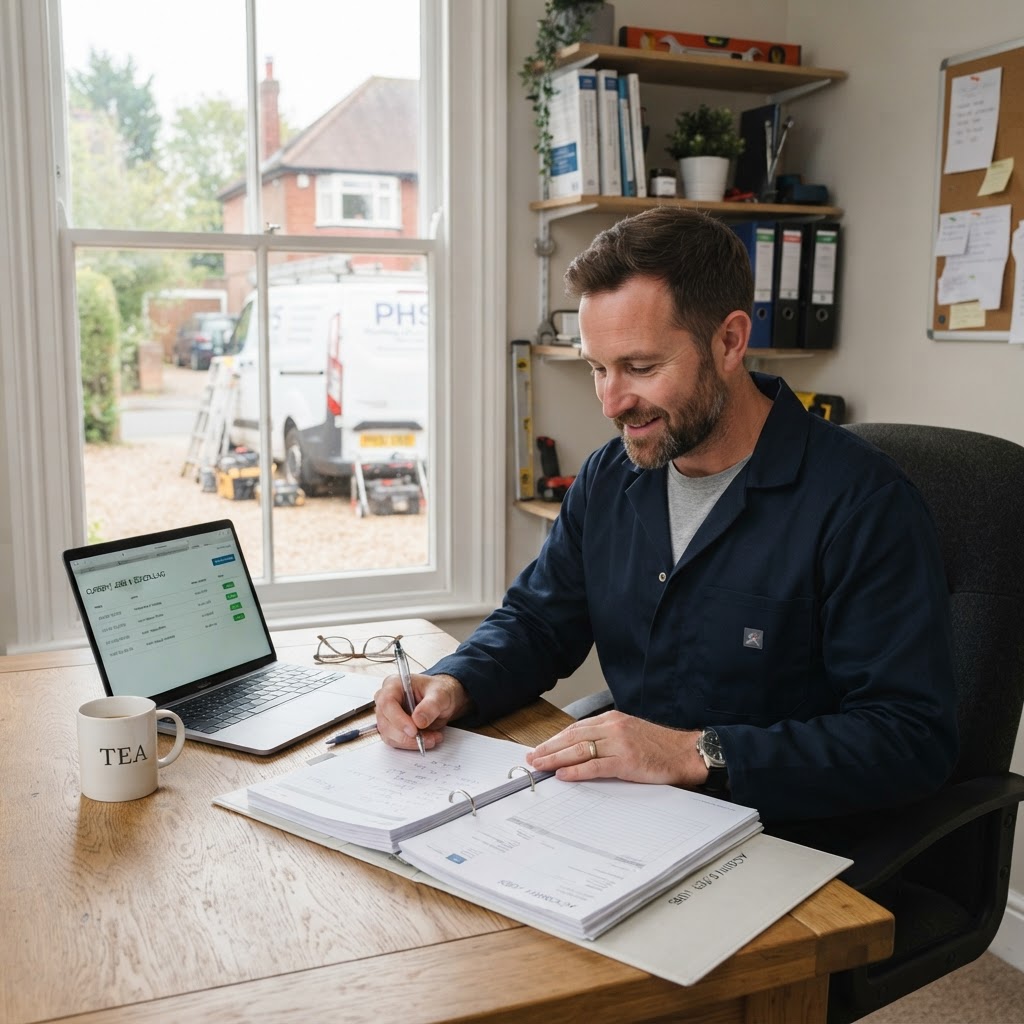
Working ON Your Trade Business, Not Just IN It
If you're still the one turning up to every job, answering every call, and writing every invoice at 10pm, you're not running a business. You're just self-employed with extra stress. Learning how to transition from working IN your business to working ON it is the thing that separates tradespeople who build something real from those who burn out after ten years.
What Does "Working ON Your Business" Actually Mean?
It's a phrase that gets thrown around a lot. But in practice, it's simple.
Working IN your business means you're doing the work. Fixing the boiler, painting the walls, rewiring the house. You're the main earner, the main doer, and if you stop showing up, the money stops coming in.
Working ON your business means you're building the systems, the team, and the processes that make the business run without needing you at every step. You're thinking about pricing strategy, not just quoting jobs. You're training your team, not just correcting their mistakes. You're looking at your numbers, not just hoping there's money in the account.
Most tradespeople spend years stuck in the first mode. Some never leave it.
Why This Matters More Than You Think
Here's a scenario that plays out constantly in Birmingham, Manchester, and London.
A plumber builds up a solid reputation. Word of mouth is strong. The phone rings every day. They take on an apprentice, maybe two. But they're still on the tools six days a week because they don't trust anyone else to do it right. They're exhausted. They can't take a holiday. They can't get sick. And the business is worth nothing if they want to sell it one day, because the business IS them.
That's not a business. That's a job with overhead.
The tradespeople who actually build wealth are the ones who get off the tools gradually, build repeatable systems, and make themselves less essential to the day-to-day. It takes time. It takes some discomfort. But it's entirely doable.
Step 1: Audit Where Your Time Actually Goes
Before you change anything, track your week honestly.
Write down everything you do in a typical week. Not what you think you do. What you actually do. Include:
- Travel time to and from jobs
- Time spent quoting
- Chasing invoices
- Answering the same customer questions repeatedly
- Buying materials
- Admin, HMRC filings, bookkeeping
- Managing staff or subcontractors
Most tradespeople are shocked. A big chunk of their week is admin and logistics, not skilled trade work. And a lot of that admin could be done by someone else, or handled by software, for a fraction of what their time is worth.
If you're billing out at £45 an hour but spending three hours a week on tasks you could pay someone £12 an hour to do, the maths is obvious.
Step 2: Identify What Only You Can Do
Some things genuinely need you. Others just feel that way.
Make a list of everything you do and ask: could someone else do this with the right training or tools?
Things that often only need you at the start:
- Building relationships with key clients
- Making decisions on pricing strategy
- Hiring and training staff
- Handling complex or unusual jobs
Things that can usually be handed off:
- Routine quotes on standard jobs
- Following up on unpaid invoices
- Booking jobs and managing the diary
- Ordering materials for known jobs
- Basic customer updates
The goal is not to disappear. It's to move your time toward the things that actually grow the business.
Step 3: Build Systems Before You Hire
A lot of tradespeople hire someone to fix a chaos problem, and then the chaos just gets bigger.
Before you bring anyone in, document how you want things done. This doesn't need to be a fancy operations manual. It can be a simple checklist or even a short voice note explaining how you handle a new enquiry, how you price a job, how you follow up after a quote.
When you write it down, two things happen. First, you realise some of your processes are actually a bit random. Second, you have something to train people from.
For example, if you run a landscaping business in Manchester, document your standard quote process. How do you measure? What's your pricing formula for turf, decking, planting? What do you always include in your quote? What questions do you ask before quoting? That becomes a training document for your next employee or apprentice.
Systems are what let the business work without you standing over it.
Step 4: Get Your Money Stuff in Order
You cannot work ON your business if you have no idea where the money is going.
This is where a lot of tradespeople struggle. They know they're busy and assume they're making money. But after materials, fuel, insurance, tools, wages, and tax, the actual profit is often much thinner than it looks.
A few things worth doing:
- Separate your business and personal finances. If you haven't already, open a dedicated business account. Makes bookkeeping simpler and HMRC will thank you for it.
- Know your actual job costs. Labour, materials, and time. Not just materials.
- Review your pricing at least once a year. Costs go up. Your prices should too.
- Set money aside for tax from every invoice. If you're a sole trader or limited company, Corporation Tax and Self Assessment bills don't wait.
If you're registered at Companies House, keep your filings up to date. It sounds obvious, but plenty of small contractors get distracted by the day-to-day and miss deadlines.
Getting a good bookkeeper, even part-time, can free up hours every month and keep you out of trouble with HMRC.
Step 5: Start Delegating, Even When It's Uncomfortable
This is the hardest part for most tradespeople.
You've built your reputation on quality. You worry that if someone else does the job, it won't be done right. That's a fair concern. But it's also something you can manage.
Start small. Let a trusted employee handle a straightforward job end-to-end. Check the work. Give feedback. Let them do it again.
Over time, as your confidence in them grows, you step back further. You go from doing every job to checking every job to occasionally checking jobs. That's the shift.
It won't happen overnight. But if you never start, it never happens at all.
Hiring in the UK
If you're taking on employees, get your head around your obligations. Employer's National Insurance contributions, workplace pensions under auto-enrolment, contracts of employment. The ACAS website is genuinely useful for this. Get it right from the start rather than trying to fix it later.
Step 6: Make Time to Actually Think About the Business
This sounds like soft advice. It isn't.
Block out two hours a week, minimum, where you are not on the tools and not doing admin. You are thinking about the business. Looking at what's working. What jobs are most profitable. Which customers are a pain and whether they're worth keeping. Whether your pricing is right. Whether you need to hire, or subcontract, or cut a service that's draining you.
Most tradespeople never do this. They're too busy. But being too busy is exactly the problem this time is supposed to fix.
Even if you start with one hour a week, the habit of stepping back and thinking strategically is what separates the tradespeople who build a proper business from the ones who stay stuck.
The Shift Doesn't Happen All at Once
Nobody goes from running every job themselves on a Monday to running a hands-off business by Friday. It's a gradual process.
The tradespeople who make it work are the ones who take small consistent steps. Document one process this week. Hand off one task next week. Have one honest look at the numbers this month.
Understanding how to transition from working IN your business to working ON it isn't about reading the right book or attending a seminar. It's about making small decisions every week that move you in the right direction.
The goal is a business that works for you, not just because of you.
Tools That Help
If you're looking for a practical starting point, Onwork is built specifically for home service businesses. It helps you manage jobs, quotes, schedules, and customer communications in one place, so less time disappears into admin and more of your week goes where it actually matters. Worth a look if you're ready to start building a business that runs properly.
Disclaimer: It is the user’s responsibility to verify the information in this article and seek professional advice where appropriate. Onwork provides this content for general informational purposes only and does not accept responsibility for decisions made based on it.


